

You need a new work truck. Or maybe it's a commercial oven, an excavator, or upgraded tech equipment. Whatever it is, you're looking at a big invoice and trying to figure out: Should I buy or lease? And more importantly, when should I pull the trigger?
Here's what most business owners miss: The price tag matters, but the timing and structure of that purchase can literally change your tax bill by five figures. We're talking $15K+ in savings just by making the right call at the right time.
Let's break down how buying versus leasing actually works in 2026, and why the decision you make in the next few months could keep a lot more cash in your business.
The Real Dilemma: It's Not Just About Affordability
Most equipment purchases happen one of two ways: You're either scrambling because something broke, or you're scaling up and need the capacity. Either way, you're probably not thinking about tax strategy, you're thinking about getting the job done.
But here's the thing. That $75,000 piece of equipment you're about to finance? The tax write-off you get depends entirely on whether you buy it or lease it, and when you actually make the purchase. Get the timing right, and you could wipe out a huge chunk of your tax liability. Get it wrong, and you'll be spreading those deductions out over years while still writing checks to the IRS.

Section 179 and Bonus Depreciation: The Tax Breaks You Actually Need to Know
Let's talk about the two biggest tax tools for equipment purchases: Section 179 and Bonus Depreciation.
Section 179 lets you deduct the full purchase price of qualifying equipment in the year you buy it, up to $1.22 million in 2024 (and similar limits expected for 2026). This isn't some complicated depreciation schedule. You buy a $50,000 truck in December? You can write off the entire $50,000 on that year's tax return.
The catch: The equipment has to be used more than 50% for business purposes, and you need to have enough taxable income to absorb the deduction. If your business only made $30,000 in profit, a $50,000 deduction doesn't help much.
Bonus Depreciation is the backup plan. It lets you deduct additional equipment costs beyond the Section 179 limit, and you can stack them together. The Tax Cuts and Jobs Act supercharged these deductions, which is why so many businesses have been able to write off equipment purchases completely in Year 1.
Here's the math that matters: A business buying $75,000 in equipment can claim the full deduction under Section 179. At a 25% tax bracket, that's $18,750 in immediate tax savings. That's real money staying in your account instead of going to Uncle Sam.
Buy vs. Lease: The Cash Flow vs. Tax Break Trade-Off
Now let's compare buying to leasing, because they work completely differently.
Buying Equipment: Big Deduction, Big Cash Hit
When you buy equipment outright (or finance it), you own it. That means you get to claim Section 179, bonus depreciation, and you can even deduct the interest on your loan payments.
Pros:
- Huge upfront tax deduction (potentially the full purchase price)
- You own the asset and build equity
- Interest on financing is deductible
Cons:
- Hits your cash flow hard, especially if you're paying cash
- You're responsible for maintenance and repairs
- Depreciation tracking gets complex (though your accountant handles that)
Leasing Equipment: Smaller Deductions, Better Cash Flow
When you lease equipment, you're essentially renting it. Your monthly lease payments are 100% deductible as a business expense, but you don't get the big upfront write-off.
Pros:
- Preserves cash flow with smaller monthly payments
- No ownership headaches, maintenance is often included
- Easier to upgrade to newer equipment when the lease ends
- Simpler accounting (just deduct the monthly payment)
Cons:
- No Section 179 deduction (unless it's a capital lease with a $1 buyout)
- Deductions spread over the lease term instead of Year 1
- You never own the asset
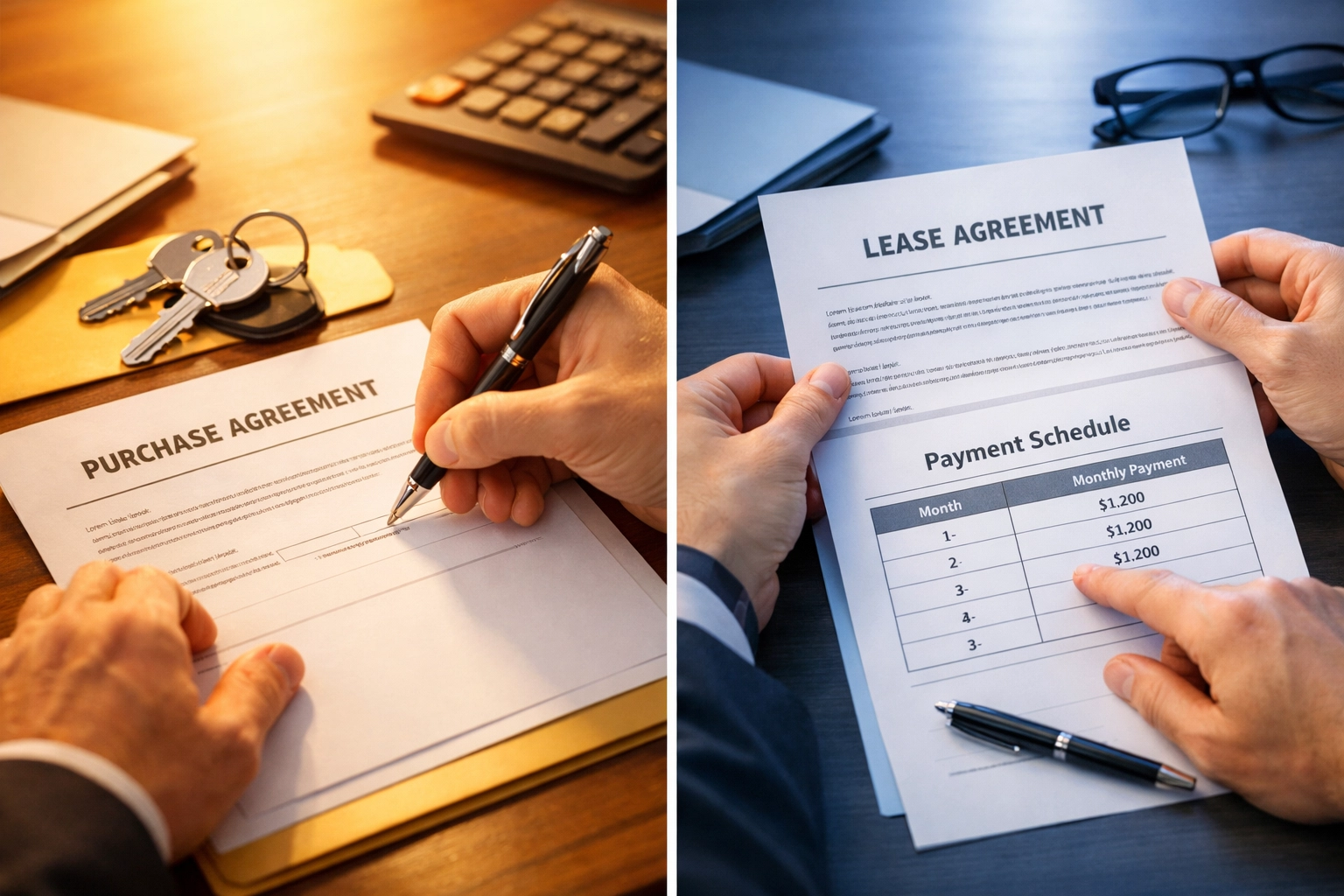
Here's the side-by-side: That same $75,000 in equipment leased over 60 months means you're deducting about $1,250 per month, or $15,000 per year. At a 25% tax bracket, that's only $3,750 in Year 1 tax savings, compared to $18,750 if you'd bought it.
The difference? $15,000 in tax savings just by choosing to buy instead of lease.
Timing Is Everything: Q4 vs. Q1 Matters More Than You Think
Here's where strategy gets really important: when you make the purchase.
Let's say it's November 2026, and you're having a strong year. You're projecting $200K in taxable income, which means you're staring down a big tax bill in April. If you buy that $75,000 piece of equipment before December 31st, you can claim the full Section 179 deduction for this tax year, cutting your taxable income to $125K and saving $18,750 in taxes.
But if you wait until January? That deduction rolls into 2027, and you're stuck paying the full freight on your 2026 taxes.
On the flip side, let's say you're having a slower year and don't have much taxable income. Buying equipment now doesn't help you, you can't use a deduction if you don't have income to offset. In that case, leasing might be the smarter play because it spreads the deduction across multiple years when you will have the income to benefit from it.
This is why timing isn't just about tax deadlines. It's about matching the deduction to your actual financial situation.
Why You Shouldn't Just "Buy Stuff Because You're Busy"
We see this all the time: Business is booming, so owners start buying equipment because they can. New truck, new tools, new everything. And yeah, you might need it. But if you're not thinking strategically about when and how you buy, you're leaving money on the table.
Buying equipment should fit into a bigger financial strategy. That means looking at:
- Your 12-month cash flow forecast
- Your projected taxable income for the year
- What you'll actually need (not just what looks shiny)
- Whether buying or leasing gives you the better outcome
This is where having a fractional CFO in your corner changes the game.

How Aces Business Solutions Helps You Make the Right Call
At Aces, we don't just look at the invoice. We look at your full financial picture, your cash reserves, your projected revenue, your tax liability, and your growth plans, and then we tell you which move keeps more cash in your pocket.
Maybe buying makes sense because you're having a killer year and need the deduction. Or maybe leasing is smarter because you need to protect cash flow for payroll and other expenses. Sometimes the answer is to wait 90 days. Sometimes it's to pull the trigger today.
We run the numbers, map out the scenarios, and walk you through exactly what each option means for your taxes, your cash flow, and your long-term strategy. That's what fractional CFO support looks like, strategic thinking that actually moves the needle, not just bookkeeping.
And yeah, we work with businesses across the board: restaurants buying new kitchen equipment, construction companies upgrading trucks and tools, real estate investors purchasing property management tech, automotive shops getting new lifts: you name it. The principles are the same, but the strategy is always tailored to your business.
Don't Sign That Lease or Purchase Order Without a Plan
Here's the bottom line: Equipment purchases are one of the biggest expenses you'll make as a business owner, and they're also one of the biggest opportunities to save on taxes. But only if you're strategic about it.
Before you sign that next lease or send the wire transfer for a big purchase, talk to someone who can help you map out the tax and cash flow impact. A 30-minute conversation could save you five figures: and that's a pretty solid ROI.
Ready to make smarter equipment decisions? Reach out to Aces Business Solutions and let's talk strategy before you buy. We'll walk you through the numbers and help you figure out the move that actually makes sense for your business.
Categories: Tax Strategy, Financial Advisory, Business Growth
Industry Tags: Restaurant, Construction & Trades, Automotive, Real Estate, Service-Based Businesses