
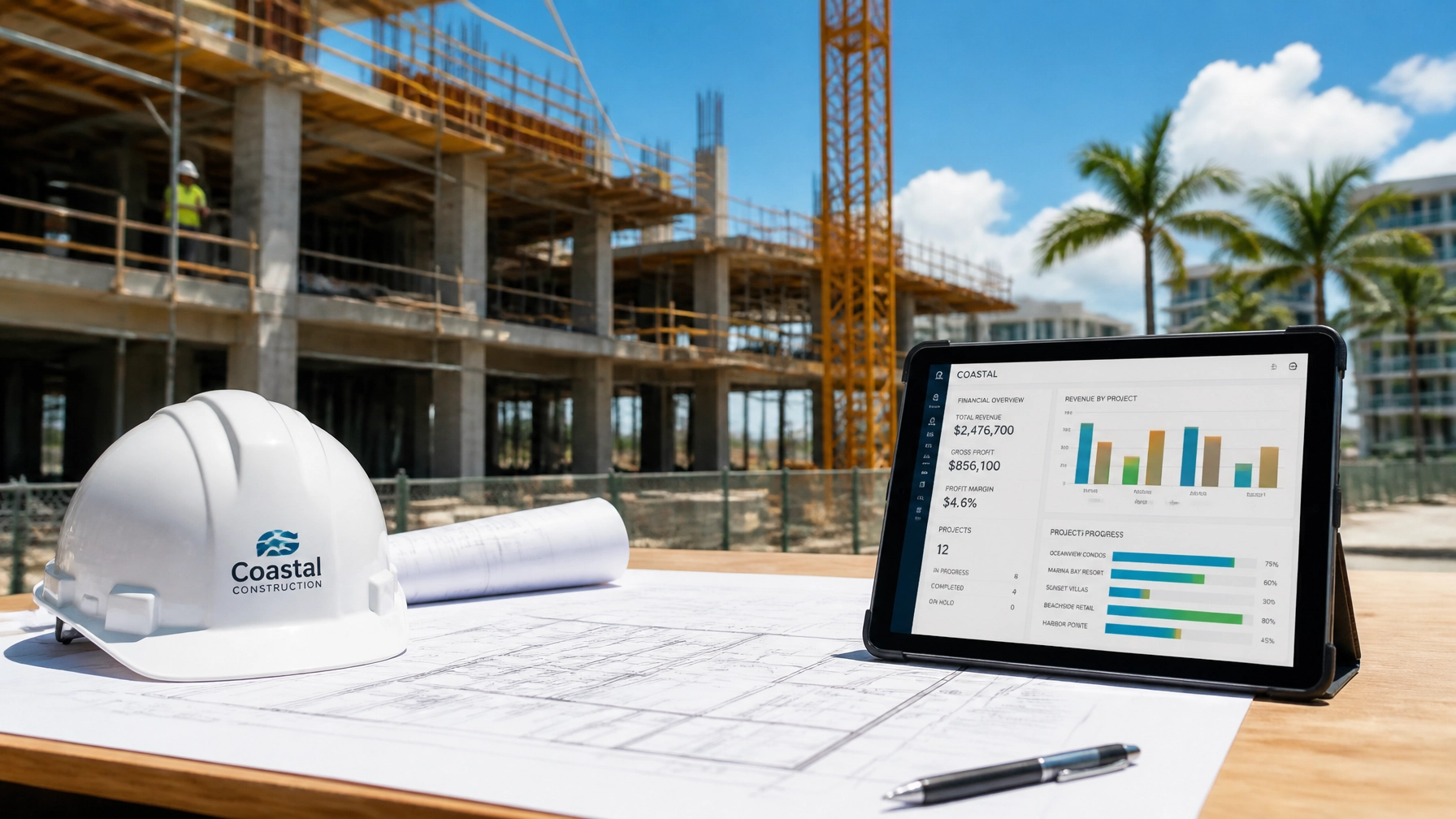
Ready to take the next step in scaling your construction company? Whether you’re a general contractor in West Palm Beach or a specialty trade shop in Fort Lauderdale, you’ve likely hit a point where the numbers in your bank account don’t seem to match the work happening on-site. You might see a massive deposit one day and feel like a king, only to realize a week later that three major material invoices are due.
This roller coaster is often the result of how you track your money. In the construction industry, the "how" usually comes down to a battle between two methods: Cash Basis and Accrual with Work-in-Progress (WIP) reporting.
Choosing the right one isn't just about satisfying the IRS; it’s about having a clear lens to see if you’re actually making money or just moving it around. Let’s dig into which method is better for your business and why your choice today could determine your ability to get bonded or take on larger projects tomorrow.
The Simple Start: Cash-Basis Accounting
Most small businesses start with cash-basis accounting because it’s intuitive. You record income when the check hits your hand and expenses when the money leaves your account. It’s the "What’s in my wallet?" method of bookkeeping.
The Pros of Cash Basis
For a startup or a very small service-based trade, cash basis has its charms:
- Simplicity: You don’t need a complex bookkeeping system to track it. If you have the cash, you record the revenue.
- Tax Benefits: You only pay taxes on the money you’ve actually received. If you’ve sent out $100,000 in invoices but haven't been paid by December 31st, you aren't taxed on that "paper" income yet.
- Real-Time Cash View: It gives you a literal view of your current liquidity.
The Cons of Cash Basis
The simplicity comes at a high cost for growing contractors:
- Distorted Profitability: Imagine you buy $50,000 in materials in June for a project that won't pay out until August. In June, your books show a massive loss. In August, they show a massive, unearned profit. Neither month reflects reality.
- Zero Visibility on WIP: You have no idea how much work you’ve "earned" but haven't billed yet, or how much you’ve billed but haven't earned.
- Growth Roadblocks: Banks and bonding companies rarely accept cash-basis financials. If you want a line of credit or a performance bond for a municipal project, you’ll need to move beyond this method.

The Gold Standard: Accrual with WIP Reporting
As your projects get longer and your overhead grows, you need a more sophisticated tool. Accrual accounting records income when it is earned and expenses when they are incurred, regardless of when the cash moves.
In construction, we take this a step further with a WIP (Work-in-Progress) Schedule. This is a reporting tool that aligns your revenue and costs to the actual progress of each project.
Why WIP is the "Secret Sauce"
A WIP schedule allows you to see two critical numbers that cash-basis accounting completely hides:
- Underbillings (Assets): You’ve done the work and spent the money, but you haven't sent the bill yet. This is money you are owed.
- Overbillings (Liabilities): You’ve sent the bill (and maybe even got paid), but you haven't done the work yet. This is "borrowed" money from your customer that you still owe in labor and materials.
If you don't track overbillings, you might look at a $200,000 bank balance and think you're rich, not realizing that $150,000 of that is needed to finish the work you've already invoiced.
The Benefits of Accrual + WIP
- True Job Costing: You can see exactly which projects are profitable in real-time. Our Fractional CFO services often use these reports to help owners decide which types of jobs to chase and which to walk away from.
- Easier Bonding and Loans: Sureties and lenders love WIP schedules. It proves you have a handle on your operations and can accurately forecast your completion costs.
- Better Strategic Planning: You can see your "backlog": the total value of work remaining on all signed contracts: which helps you plan for hiring and equipment purchases.

WIP vs. Cash Basis: A Head-to-Head Comparison
| Feature | Cash Basis | Accrual + WIP |
|---|---|---|
| Complexity | Low – Easy to manage | High – Requires expert financial reporting |
| Accuracy | Poor – Timing gaps distort profit | Excellent – Matches costs to revenue |
| Tax Strategy | Flexible – Delay taxes by timing bills | Fixed – Taxed as income is earned |
| Bonding | Not acceptable for most sureties | Preferred/Required for growth |
| Cash Flow | Clear "now" picture | Requires separate forecasting |
Which One Is Better for Your South Florida Business?
The answer depends on where you are and where you’re going.
If you are a solo tile installer doing residential repairs where you get paid the day the job is finished, Cash Basis is likely sufficient. It keeps your accounting fees low and your tax planning simple.
However, if you are a commercial HVAC contractor, a home builder, or a specialized subcontractor with projects that last more than a month, you likely need Accrual with WIP. Without it, you are essentially flying a plane without a dashboard. You might feel like you're soaring, but you won't know you're running out of fuel until the engines cut out.
The "Hybrid" Solution
Many of our clients at Aces Business Solutions use a hybrid approach. We maintain their internal books on an Accrual/WIP basis so they can manage the business with precision and get the bonding they need. Then, for their tax planning, we may convert those numbers back to a cash basis (if they meet IRS thresholds) to minimize their immediate tax liability. It’s the best of both worlds: clarity for the business, and savings for the bank account.
How to Make the Transition
Moving from cash to accrual isn't just about flipping a switch in QuickBooks. It requires a mindset shift and a partner who understands the nuances of the construction industry. Our team at Aces Business Solutions specializes in helping South Florida contractors turn financial chaos into actionable insight.
We’ll walk you through:
- Setting up a robust job costing system.
- Developing a monthly WIP schedule that actually makes sense.
- Analyzing your over/under billings to protect your cash flow.
- Preparing the professional financials your bank and bonding agent are asking for.
Let's start building a more profitable future together. Whether you need a cleanup of your current books or a high-level strategic partner to guide your growth, we’re here to help you scale with confidence.
Ready to get clear on your numbers? Contact us today for a consultation tailored to your construction business.
Categories: Business Growth, Financial Advisory, Tax Strategy
Industry Tags: Construction & Trades, Real Estate